
Legends of White Tea: A Thousand Years of Heritage from Goddess Taimu to Cultural Symbol
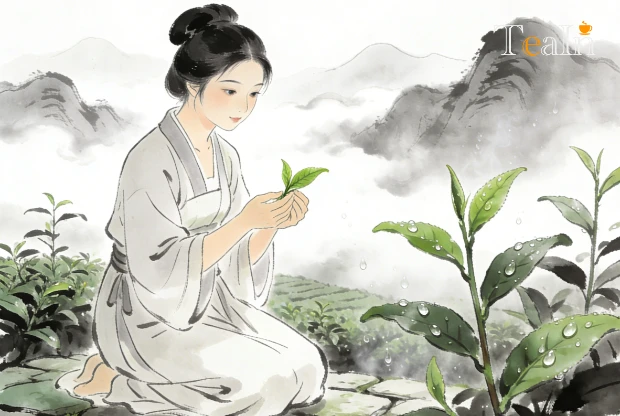
As one of China’s oldest tea varieties, white tea has won the hearts of tea lovers worldwide with its smooth, sweet aftertaste. Beyond its flavor, it carries legends spanning millennia. Originating in the Taimu Mountains of Fuding, Fujian, these stories weave together mythology, filial piety, and cross-cultural exchange, turning a simple leaf into a unique symbol connecting history, humanity, and spiritual beliefs. For those seeking to understand white tea’s cultural roots, these legends are more than ancient tales—they are the key to grasping its essence as "both food and medicine" and a "bridge of cultural integration."
I. Goddess Taimu and Lüxueya: The Mythical Origin of White Tea
In the folk legends of Taimu Mountain, white tea’s birth is inseparably linked to a kind-hearted peasant woman named Lan Gu. During the reign of Emperor Yao, Taimu Mountain was then called "Caishan" (Talent Mountain). Lan Gu, who fled war to take refuge in the mountains, lived in poverty but devoted herself to caring for the local flora. One day, she stumbled upon a rare tea tree growing atop Hongxue Cave—its leaves as green as jade and young buds covered with snow-like fine white hairs, distinct from all other plants around.
Tragedy struck when a measles epidemic swept through the region, claiming countless lives, especially children. Desperate villagers searched for a cure in vain. One night, an anxious Lan Gu dreamed of the Immortal of the South Pole, who instructed her: "The tea tree atop Hongxue Cave is called Lüxueya. Dry its leaves and boil them to drink, and it will cure the measles." Awakened by the dream, Lan Gu braved the perilous mountain path to climb the cave at night. She picked the young buds, dried them, and taught villagers to boil the leaves for their sick children. Miraculously, many children recovered, and the epidemic gradually subsided.
To benefit more people, Lan Gu did not hoard the "fairy tea." Instead, she carefully cultivated seedlings and gave them to neighbors. Over time, tea gardens spread across the Taimu Mountain area, and Lüxueya became the "life-saving tea" of the local people. Grateful for her kindness, villagers honored her as "Tai Mu" (Great Mother), and Caishan was renamed "Tai Mu Shan" (Taimu Mountain). Later, Emperor Yao heard of her deeds and conferred upon her the title "Goddess Taimu," enshrining her as a deity.
This legend is not a fabrication. Today, a thousand-year-old ancient tea tree still stands at the entrance of Hongxue Cave on Taimu Mountain. Recorded in The Great Dictionary of Chinese Tea as the original parent tree of "Fuding Dabai Tea," it is known locally as Lüxueya. Lu Yu, the Sage of Tea in the Tang Dynasty, wrote in The Classic of Tea: "Three hundred li east of Yongjia County lies a white tea mountain." Verified by Zhang Tianfu, a modern tea scholar, this "white tea mountain" is none other than Taimu Mountain. The legend of Goddess Taimu thus became the earliest cultural footnote to white tea’s dual role as food and medicine.
II. Chen Huan and White Tea: Variety Inheritance Rooted in Filial Piety
If Goddess Taimu’s legend endows white tea with mythic charm, the story of Chen Huan in the Qing Dynasty adds human warmth and perseverance to its heritage. Born in 1813 in Guojian Village, Diantou Town, Fuding, Chen Huan was renowned for his filial piety. According to Fuding County Chronicles, he lived in poverty and struggled to provide for his parents despite working tirelessly. Tormented by guilt, he longed to find a way to improve their lives.
After New Year’s Eve one year, Chen Huan observed a three-day fast, packed provisions, and climbed Taimu Mountain to pray for Goddess Taimu’s guidance. After burning incense and worshipping at Hongxue Cave, he fell into a deep sleep. In his dream, a woman in plain clothes (believed to be the incarnation of Goddess Taimu) pointed to a tea tree and said: "This is a fine tree in the mountains, planted by my own hands. You can take cuttings and cultivate them—they will surely help you make a living." Upon waking, Chen Huan searched the mountains and finally found the unique tea tree near Hongxue Cave—it was the Lüxueya cultivated by Goddess Taimu in legend.
He carefully took a seedling and nurtured it at home. The seedling thrived under his care, producing buds dense with white hairs. When brewed, the tea yielded a sweet liquor with a distinctive aroma. Chen Huan dried the leaves and sold them. Due to its exceptional quality, demand soon outstripped supply, and the tea’s price even matched that of silver. Not only did he use the income to lift his family out of poverty, but he also shared seedlings with neighbors, driving the entire village to grow tea. By the first year of the Republic of China, Fuding’s annual white tea output had reached 50,000 kilograms, becoming a pillar industry of the region.
Folk tales also tell of Chen Huan using white tea to honor his mother: it is said his mother had lost her sight, and Chen Huan heard that boiling white tea leaves could improve eyesight. He picked fresh buds every day to make tea for her to wash her eyes, and over time, her vision gradually recovered. This story elevated white tea’s inheritance beyond mere agricultural production, infusing it with the humanistic spirit of filial piety. It transformed Fuding white tea from a mountain tree into a cultural carrier of family warmth.
III. Wang Zhaojun and White Tea: A "Peace Envoy" for Cross-Cultural Exchange
White tea’s legends are not confined to southeastern China. In the story of Wang Zhaojun’s marriage to the Xiongnu in the Han Dynasty, it played a role in cross-cultural exchange, becoming a "peace envoy" connecting the Central Plains and the grasslands. In 33 BCE, to end border conflicts between the Han Dynasty and the Xiongnu, Wang Zhaojun volunteered to marry the Xiongnu chieftain. Before her departure, she took not only Central Plains culture and craftsmanship but also white tea seeds from her hometown of Xingshan, Hubei, sewing them into her garment to carry a piece of "hometown vitality" on her long journey.
During her journey north, Zhaojun noticed that the Xiongnu relied heavily on beef and mutton for sustenance. Their diet was greasy and apt to cause internal heat, leaving many herdsmen and children suffering from high fevers. Remembering her mother’s teachings—"Tea can cure illnesses and calm the mind"—she planted the white tea seeds. Once the trees sprouted, she picked the leaves, boiled them, and shared the tea with the herdsmen. The liquor not only relieved the greasiness of their diet but also reduced fevers in sick children. Astonished, the Xiongnu called white tea a "fairy herb" and honored Zhaojun as "Ninghu Yanzhi" (Queen Who Brings Peace).
During her time on the grasslands, Zhaojun taught Xiongnu women white tea’s natural withering and drying techniques. Adapting to the grasslands’ drying customs, they made storable tea bricks. These bricks not only became a daily drink for herdsmen but also reduced tribal conflicts caused by alcohol, gradually evolving into a "life-giving beverage" shared by both Han and Xiongnu peoples. Legend has it that before her death, Zhaojun gave her treasured white tea seeds to the leaders of various tribes, urging them: "This plant fears no wind or snow, just like the friendship between the Han and Xiongnu." After her passing, a cold-resistant tea tree grew on her tomb, its leaves shaped like spreading pigeon wings. Known as the "pigeon tree," it symbolized the vision of cross-ethnic peace.
Li Shangyin, a poet of the Tang Dynasty, wrote "How many times have I dreamed of tea in Zhaoyang Palace," weaving Zhaojun’s memory of white tea into verse. In Ma Zhiyuan’s Autumn in the Han Palace of the Yuan Dynasty, the scene of "lute strings steeped in tea aroma" recreated white tea’s significance in Zhaojun’s life. Today, Zhaojun’s tea gardens in Xingshan, Hubei, and tea factories in Inner Mongolia continue this legend, producing "Zhaojun’s Marriage" tea bricks that serve as a cultural symbol of ethnic unity. White tea, once a plant of the Central Plains, has become a cultural bridge spanning regions and nations.
IV. The Continuation of Legends: From Tales to Real-World Cultural Heritage
After a thousand years, white tea’s legends have transcended mere myth to merge with real-world cultural inheritance. The ancient Lüxueya tea tree on Taimu Mountain still buds every year. In 2011, Fuding white tea’s production techniques were included in China’s National Intangible Cultural Heritage List. In 2022, "Traditional Chinese Tea Processing Techniques and Their Related Customs" was inscribed on the UNESCO Intangible Cultural Heritage List, giving white tea’s legends a modern footnote.
These legends have endured for millennia not only because they tell the "origin of a leaf" but also because they embody universal human values: Goddess Taimu’s story reflects "kindness and redemption," Chen Huan’s tale conveys "filial piety and perseverance," and Wang Zhaojun’s narrative embodies "tolerance and peace." For Western audiences, these stories may stem from a different cultural background, but their humanistic spirit resonates universally. Just as wine has chateau legends and coffee has origin stories, white tea’s tales give this beverage warmth and depth.
Today, when people sip a cup of white tea on Taimu Mountain, watching the Lüxueya leaves unfurl in the liquor, or encounter Chinese white tea at an overseas tea ceremony, they taste more than just a smooth brew—they experience a cultural memory spanning a thousand years. The legends of Goddess Taimu, Chen Huan, and Wang Zhaojun have long become the soul of white tea, transforming it from a mountain plant into a cultural symbol connecting past and future, East and West.
Summary
This article explores the legends of white tea, tracing its thousand-year heritage from mythic origin to cultural symbol. It focuses on three classic tales: first, the legend of Goddess Taimu (Lan Gu) in Fuding’s Taimu Mountain, who discovered the Lüxueya tea tree, cured a measles epidemic with its leaves, and was enshrined by Emperor Yao—this legend confirms white tea’s dual role as food and medicine, supported by the surviving ancient parent tree. Second, the story of Chen Huan in the Qing Dynasty, whose filial piety led him to transplant the sacred tea tree after a dream, improving his family’s life, curing his mother’s blindness, and driving the large-scale cultivation of Fuding white tea. Third, the cross-cultural legend of Wang Zhaojun in the Han Dynasty, who brought white tea seeds to the grasslands, taught the Xiongnu to make and use tea, relieved their dietary discomfort, and promoted cultural exchange, making white tea a "peace envoy." The article also highlights the real-world continuation of these legends, such as Fuding white tea’s inclusion in UNESCO’s intangible cultural heritage. It emphasizes that these tales are more than stories—they carry the humanistic spirits of kindness, filial piety, and peace, making white tea a unique bridge between Eastern culture and the world.