
Must Aged White Tea Be Deep Black? Variety Differences & Identification Guide
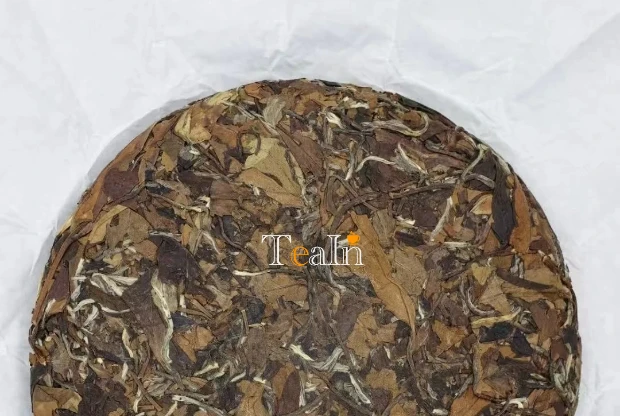
Many tea lovers have the intuitive impression that aged white tea is dark in color, even falling into the misunderstanding that "the darker the color, the older the vintage." In reality, aged white tea is not uniformly deep black. Different varieties develop unique color characteristics after natural aging. Blindly taking "deep black" as the standard to judge quality can easily lead to purchasing inferior tea.
Naturally aged white tea exhibits distinct color differences by variety. For Shoumei and Gongmei, the raw materials are mainly mature large leaves with tea stems. The leaves have thick cell walls and high contents of lignin and fiber. During long-term aging, the pigment substances transform fully, so they mainly present a deep brown base color, mixed with dark green, cyan, yellow and other colors, forming rich color layers, which are by no means a single deep black. For Bai Mudan, the raw materials are mainly buds and leaves, with plump buds and tender leaves. The surface of the buds is covered with fine white down, which retains part of the silver-gray color during aging. The leaves are mainly dark cyan and dark green, with an overall lighter color. They will not have the deep color of Shoumei and Gongmei, and it is even harder to present a pure deep black.
The misunderstanding that "aged white tea must be deep black" often becomes an entry point for unscrupulous merchants to counterfeit. Some Bai Mudan cakes with abnormally deep black color on the market are likely to have two problems: one is raw material counterfeiting. Merchants use large leaves and tea stems of Shoumei and Gongmei as the base material to press into Bai Mudan cakes, taking advantage of the easy discoloration of Shoumei and Gongmei to pass off as high-vintage Bai Mudan; the other is artificial aging, which uses forced methods such as high-temperature pile fermentation and watering and damp stacking to make the tea leaves turn black quickly in a short time, imitating the appearance of aged tea. More commonly, the two counterfeiting methods exist simultaneously: using inferior raw materials to reduce costs and covering up the truth through artificial aging. Such tea not only lacks the flavor that aged white tea should have but may also have health hazards due to improper processing.
To avoid falling into traps, you can identify the authenticity of aged white tea's color through simple methods. First, look at the color layers. No matter which variety, naturally aged tea will not have a uniform and rigid color. Shoumei and Gongmei have mixed colors such as deep brown and dark green, while Bai Mudan has a combination of dark green and silver gray. However, artificially aged or counterfeit tea often has a single deep black color, lacking natural layers. Second, check the ratio of buds to leaves. Bai Mudan has a high ratio of buds to leaves, and obvious buds and tender leaves can still be seen even after years of aging. If a "Bai Mudan" cake is full of large leaves and tea stems, it is likely to be raw material counterfeiting. Finally, smell the aroma. Naturally aged tea has warm aromas such as jujube and medicinal notes, while artificially aged tea may have musty, sour or burnt odors, which are completely different from the aroma of normal aged tea.
The charm of aged white tea lies in the flavor and color evolution brought by natural aging, which varies by variety and has no uniform "deep black" standard. The deep brown mixed colors of Shoumei and Gongmei, and the dark green and silver gray of Bai Mudan are all normal manifestations of their respective varieties. When tasting and choosing tea, we should not adhere to the idea that "the darker the better." Instead, we should understand the color characteristics of different varieties and make a comprehensive judgment combined with aroma, bud-leaf ratio, etc., so as to truly select high-quality aged white tea.
Summary
This article addresses the core question "Must aged white tea be deep black?" and clarifies the misunderstanding that "the darker the color, the older the vintage." It points out that naturally aged white tea varies in color by variety: Shoumei and Gongmei are mainly deep brown with mixed colors; Bai Mudan is mainly dark cyan and dark green with silver-gray buds, and will not present a pure deep black. At the same time, it reveals that abnormally deep black Bai Mudan cakes are mostly products of raw material counterfeiting (Shoumei or Gongmei passed off as Bai Mudan) or artificial aging. The article provides identification methods such as checking color layers, bud-leaf ratio, and smelling aroma, emphasizing that there is no uniform standard for the color of aged white tea. The quality should be comprehensively judged according to the variety characteristics, avoiding blind pursuit of deep black.