
The Evolution of White Tea: A Dynastic Timeline from Ancient Times to Modernity
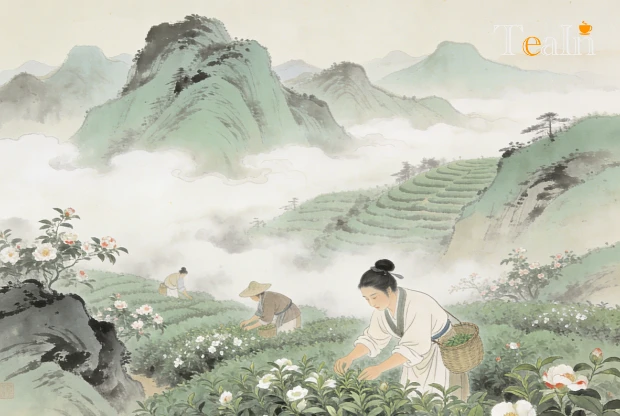
As one of China’s oldest tea varieties, white tea boasts a history spanning thousands of years, witnessing the germination, prosperity, and global spread of Chinese tea culture. From its medicinal origins in ancient times to royal admiration during the Tang and Song dynasties, and its modern rise as a global wellness favorite, white tea’s development has been closely intertwined with dynastic changes, craftsmanship innovations, and cultural inheritance. Below is a chronological overview of white tea’s key milestones across dynasties, revealing its profound historical heritage.
I. Ancient Times to the Reign of Emperor Yao: Origins and the Emergence of "Food as Medicine"
White tea’s roots trace back to ancient times. According to Shennong Ben Cao Jing (Shennong’s Herbal Classic), "Shennong tasted a hundred herbs, encountering seventy-two poisons in a single day, and was cured by tea." The "tea" here refers to early tea in general. The practice of picking fresh tea leaves and drying them for storage—used by ancient people—bears striking similarities to modern white tea’s core craftsmanship of natural withering without pan-frying or rolling. Tea scholar Yang Wenhui notes that this sun-drying method marked the beginning of tea processing, making white tea the earliest tea variety in China’s tea production history, hailed as a "living fossil of tea."
During the reign of Emperor Yao, white tea’s medicinal value was first systematically applied. At the foot of Taimu Mountain in Fuding, Fujian, a kind-hearted woman named Lan Gu discovered that buds and leaves from wild tea trees (later known as Lüxueya) could alleviate illnesses. When a measles epidemic broke out, claiming countless children’s lives, Lan Gu picked the tea buds, dried them, and taught villagers to boil the leaves for sick children. The epidemic was eventually contained. Grateful villagers revered her as a deity, and Emperor Yao later enshrined her as "Goddess Taimu." This legend not only endows white tea with humanistic charm but also confirms its essence as "both food and medicine." A thousand-year-old Lüxueya tea tree still stands at the entrance of Hongxue Cave on Taimu Mountain, serving as tangible evidence of this history.
II. Qin to Han Dynasties: Spread of Tea-Drinking Customs and Early Commercialization
At the end of the Warring States period, after the Qin Dynasty conquered the Ba and Shu kingdoms (modern-day Sichuan), tea-drinking customs that had been confined to the Sichuan Basin began to spread to the Central Plains. Before then, due to the perilous Shu Roads, tea was nearly exclusive to the people of Ba and Shu, reaching other vassal states only through occasional tributes. Following unification, the Qin Dynasty’s territorial expansion facilitated the diffusion of tea culture, laying the groundwork for white tea’s subsequent development.
The Han Dynasty marked a crucial transition for white tea from "medicine" to "daily beverage." The Western Han literatus Wang Bao recorded in Tong Yue (Contract with a Servant) phrases like "boil tea with full utensils" and "buy tea in Wuyang," where "tu" (bitter herb) refers to tea. These are China’s earliest written records of tea commerce and dedicated tea-drinking utensils. "Buying tea in Wuyang" indicates the emergence of specialized tea markets, while "boiling tea with full utensils" shows that tea-drinking had formed a set of ritual practices. Additionally, tea became an important part of social etiquette, with serving tea to guests becoming a common custom, expanding white tea’s consumption scenarios from family to social settings.
III. Wei, Jin, Southern and Northern Dynasties: Buddhist Influence and the Dawn of Tea Culture
Though marked by frequent political upheaval, the Wei, Jin, Southern and Northern Dynasties saw the rise of Buddhism, which injected new momentum into tea culture. Buddhist monks discovered that tea could refresh the mind and enhance concentration during meditation, leading them to actively promote tea-drinking—a practice that laid the foundation for the "unity of Zen and tea." During this period, tea-producing regions expanded from Sichuan and Fujian to the Yangtze River Delta and Lingnan. White tea, once a local specialty of Taimu Mountain and Zhenghe in Fujian, gradually became a common beverage among the people.
While white tea’s processing remained centered on natural withering and drying, people began to pay more attention to storage methods to avoid flavor contamination. Tea garden management experience from Buddhist temples also advanced tea cultivation techniques, paving the way for the large-scale development of white tea in the Tang Dynasty.
IV. Tang Dynasty: Establishment of the "White Tea" Name and Recognition of Core Producing Areas
The Tang Dynasty was a "golden age" for Chinese tea culture, with tea evolving from a daily drink to the "national beverage." White tea gained its first clear literary mention during this period. Lu Yu, the "Sage of Tea," cited the Sui Dynasty text Yongjia Tu Jing (Yongjia Regional Records) in The Classic of Tea, stating: "Three hundred li east of Yongjia County lies a white tea mountain." Later tea scholars Chen Chuan and Zhang Tianfu verified that "east" was likely a copyist’s error for "south," referring to modern-day Fuding (then part of Changxi County in Fujian). This conclusion confirmed Fuding as white tea’s core producing area and officially established "white tea" as an independent tea variety.
The Tang literatus Yang Hua also noted in Shanfu Jingshou Lu (Records of a Chef’s Experiences) that "today, there is eagle-beak white tea on Mount Mengding." While white tea was also grown in Sichuan’s Mount Mengding, Fujian white tea—with its fresh taste preserved through natural withering—was particularly favored by literati. Fueled by the Tang Dynasty’s prosperous commerce, tea trade flourished. White tea was transported from Fujian to major cities like Chang’an and Luoyang via canals and the Silk Road, becoming a staple at literati gatherings.
V. Song Dynasty: Royal Patronage and the Legend of "Naming a County After Tea"
The Song Dynasty marked the pinnacle of white tea’s status, as it ascended from a folk beverage to "royal tribute tea" through the Beiyuan Tribute Tea system. The Beiyuan Imperial Tea Garden (located in modern-day Jian’ou, Fujian) supplied tea exclusively to the imperial court, and Zhenghe (then known as Guanli County) became a key supplier due to its high-quality white tea.
Emperor Huizong of Song was particularly fond of white tea. In Da Guan Cha Lun (Treatise on Tea in the Daguan Era), he wrote exclusively about white tea: "White tea is a category of its own, distinct from ordinary tea. Its branches spread gracefully, and its leaves are thin and luminous. Growing spontaneously in cliff forests, it cannot be cultivated by human effort." He praised it as a "treasure among teas." At that time, tea officials at Beiyuan held tea competitions to select the finest white tea. Zhenghe white tea, with its dense white hairs and long-lasting white froth after brewing, often won first place. The tribute tea "Longtuan Shengxue" (Dragon Ball Surpassing Snow) ranked top among all tribute teas.
In 1115, Guanli County presented white tea as a tribute to the imperial court. Emperor Huizong deemed "Guanli" (meaning "customs station") too crude for such an elegant tea, renaming the county "Zhenghe" after his own reign era. Zhenghe thus became the only county in China named after tea—a classic story in white tea culture. Additionally, the Song literatus Cai Xiang praised white tea in Ode to Baihao Tea, writing "Beiyuan’s spiritual buds are the finest under heaven," further confirming white tea’s noble status.
VI. Ming Dynasty: Craft Innovation and the Rise of Loose Tea
In the early Ming Dynasty, Emperor Zhu Yuanzhang, advocating frugality, issued an edict banning the production of elaborate compressed tea cakes, promoting the shift to simpler loose tea. This policy aligned perfectly with white tea’s natural withering and non-processed craftsmanship, ushering in a new era for white tea.
The Ming literatus Tian Yiheng clearly advocated for white tea in Zhuquan Xiaopin (Notes on Boiling Spring Water), stating: "Tea made with fire is inferior; sun-dried tea is superior." He praised sun-dried tea for its "upright leaves and bright green color when brewed." According to Records of China’s Famous Teas, Fuding white tea had become a nationally renowned tea by the Ming Dynasty, cherished for its fresh and sweet taste among people in the Yangtze River Delta.
Furthermore, the tea classification system became more refined during the Ming Dynasty, expanding from a single green tea category to include black, yellow, and dark teas. White tea’s status as an independent variety was initially established, laying the groundwork for the final formation of China’s six major tea categories in the Qing Dynasty.
VII. Qing Dynasty: Folk Popularization, Mature Craftsmanship, and Global Spread
The Qing Dynasty saw white tea "move from the imperial court to the people." Tea culture shifted from being dominated by literati to flourishing among the general public, with teahouses becoming social hubs and white tea emerging as a daily staple. During this period, white tea’s craftsmanship matured further. In 1796 (the 60th year of Emperor Qianlong’s reign), Fuding tea farmers created "Baihao Yinzhen" (Silver Needle) using plump buds from local Cai Cha (wild tea trees). Named for its silver hair-covered buds resembling silver needles, the tea was later produced using buds from Fuding Dabai (Big White) tea trees starting in 1885, resulting in superior quality.
Zhenghe white tea also reached its peak during the Qing Dynasty. In 1879, Wei Chunsheng, a farmer from Tieshan Township in Zhenghe, invented the "tea tree layering method," enabling large-scale cultivation of white tea trees. A local proverb—"When marrying a daughter, one does not covet official families, but inquires about Baihao and Lianxin (fine white tea)"—attests to white tea’s precious status in society.
In the mid-to-late Qing Dynasty, Chinese tea began to be exported globally on a large scale. White tea, along with black and green tea, was shipped from Fuzhou Port to Europe, America, and Southeast Asia. Initially used as a decorative addition to black tea, Baihao Yinzhen gradually gained recognition as an independent variety due to its unique flavor and health benefits. Particularly in Hong Kong and Guangdong, Shoumei (Eyebrow Tea) became a staple in teahouses for its affordability and heat-clearing properties.
VIII. 20th Century to Present: Academic Recognition and Global Popularity
The 20th century marked a "scientific era" for white tea. In 1963, tea scholar Zhang Tianfu published Survey and Research on Fujian White Tea, officially confirming that "white tea originated in Fuding." In 1979, Professor Chen Chuan classified white tea as one of China’s six major tea categories in Theory and Practice of Tea Classification, establishing its academic status. In 1982, Fuding Baihao Yinzhen won first place at China’s first National Famous Tea Evaluation, boosting white tea’s national reputation.
The 21st century has brought global success to white tea: Fuding was named "China’s Hometown of White Tea" in 2006, Fuding white tea received national geographical indication protection in 2009, and its production techniques were included in China’s National Intangible Cultural Heritage List in 2011. Scientific research has also validated white tea’s health benefits—studies by the Chinese Center for Disease Control and Prevention (CDC) have shown its blood sugar-lowering effects, while research led by Academician Liu Zhonghua has confirmed its anti-aging and skin-benefiting mechanisms. Today, white tea is not only a traditional Chinese famous tea but also a rising star in the global wellness beverage market, cherished by Western consumers for its natural and healthy properties.
Summary
This article traces the evolution of white tea across Chinese dynasties, from its medicinal origins in ancient times (Shennong tasting herbs, Lan Gu curing measles) to the spread of tea-drinking customs and early commerce during the Qin and Han dynasties (recorded in Tong Yue, formation of etiquette). It covers the Buddhist-influenced dawn of tea culture in the Wei, Jin, Southern and Northern Dynasties, the establishment of the "white tea" name and recognition of producing areas in the Tang Dynasty (mentioned in The Classic of Tea), royal patronage during the Song Dynasty (Emperor Huizong renaming Zhenghe County, Da Guan Cha Lun), craft innovation with loose tea in the Ming Dynasty after the ban on compressed tea, the maturity of craftsmanship and global export in the Qing Dynasty (invention of Baihao Yinzhen), and academic recognition and global popularity in the 20th century and beyond. Key milestones—including craft innovations, literary records, cultural impacts, and trade diffusion—weave together white tea’s thousand-year timeline. It showcases the profound heritage of Chinese tea culture while highlighting white tea’s core traits of "naturalness and health," making it a unique tea variety bridging ancient traditions and the modern global market.