
Why Is Aged White Tea’s Liquor Color Rich Red?
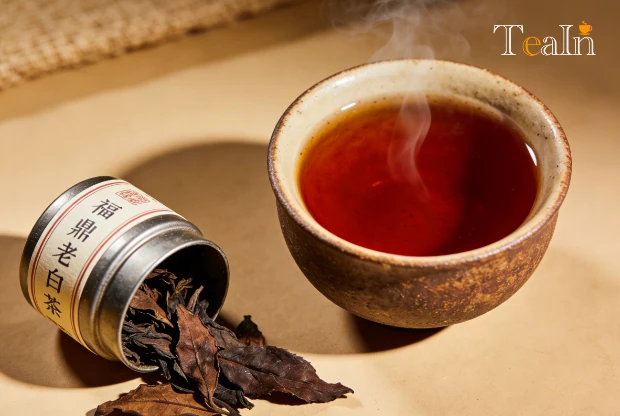
In the tasting and collection of white tea, changes in liquor color are the most intuitive mark of time. Fresh white tea typically presents a clear apricot yellow or pale yellow hue. In contrast, aged white tea that has undergone years of aging gradually turns to a rich red amber or orange-red color, especially evident in aged Shoumei and aged Gongmei. This color transformation is no coincidence but the result of continuous internal component changes during aging. It not only reflects the aging state of white tea but also is closely linked to changes in flavor and nutrition. Combining tea biochemistry principles and aging practices, this article analyzes the core reasons for the rich red liquor color of aged white tea from three dimensions—component transformation, aging conditions, and variety characteristics—to help readers understand the time code behind the liquor color.
I. Core Reason: Polyphenol Transformation Drives Color Change
The fundamental cause of the rich red liquor color in aged white tea lies in the slow transformation of polyphenols in the tea. Fresh white tea is high in polyphenols (mainly catechins and EGCG), which are pale yellow, giving the fresh tea a clear, yellowish liquor color. During long-term aging, these unstable polyphenols undergo oxidation and polymerization reactions, gradually forming three key pigments: theaflavins, thearubigins, and theabrownins. It is the changing ratio of these three that dominates the transformation to a rich red liquor color.
Theaflavins form the basis of the liquor’s bright orange-yellow hue. Their content gradually increases in the early stages of aging, turning the liquor from pale yellow to amber yellow. As aging progresses, theaflavins further polymerize to form thearubigins, which are deep red and the core contributor to the rich red color of aged white tea. For aged white tea stored for more than 10 years, some thearubigins continue to polymerize into theabrownins, darkening the liquor to dark red or chestnut red while bringing a more mellow taste. The dynamic balance of these three pigments creates a gradual time trace in the liquor color of aged white tea—from pale yellow to orange-red, and then to rich amber red.
In addition, the formation of these pigments is accompanied by the enrichment of nutrients. Studies show that aged white tea stored for more than 5 years has a total content of thearubigins and theabrownins 3 to 4 times that of fresh tea. These substances not only affect the liquor color but also have mild antioxidant effects and cardiovascular protection benefits, synchronously enhancing the drinking and collection value of aged white tea.
II. Aging Conditions: Mild Environment Promotes Uniform Rich Red Color
The richness and uniformity of the liquor color in aged white tea are inseparable from suitable aging conditions. The core requirements for white tea aging are "dryness, ventilation, light protection, and odorlessness." Such an environment allows for gentle and sufficient transformation of tea components, ultimately forming a bright and rich red liquor color.
A dry and ventilated environment prevents the tea from getting damp and moldy, enabling the slow oxidation of polyphenols. This results in the uniform formation of thearubigins and theabrownins, giving the liquor a clean amber red or orange-red color without turbidity. If the aging environment is humid and poorly ventilated, the tea may become moldy or oxidize rapidly, leading to a dull and turbid liquor color that lacks the luster of richness. Light protection during storage prevents ultraviolet rays from damaging pigment precursors in the tea, avoiding a pale or uneven liquor color.
Temperature also affects color transformation, with a room temperature of 20 to 25℃ being optimal. Excessively high temperatures accelerate component transformation, causing the liquor to turn red prematurely but with a bland flavor. Conversely, excessively low temperatures slow down transformation, making it difficult for the liquor to achieve a rich red color even after years of storage.
III. Variety Characteristics: Leaf-Stem Ratio Determines Richness of Red Color
There are significant differences in the richness of red liquor color among different white tea varieties after aging, which is closely related to the leaf-stem ratio of the raw materials. Aged Shoumei and aged Gongmei have the richest red liquor color, while aged Baihao Yinzhen has a relatively lighter color, mostly deep amber yellow. The core reason lies in the different proportions of leaves and stems in the raw materials.
Shoumei and Gongmei are mainly made from mature leaves and stems. These raw materials have higher contents of polyphenols, pectin, and soluble sugars than young buds. During aging, polyphenols in leaves and stems can be more fully transformed into thearubigins and theabrownins. Additionally, pectin components make the liquor more thick and bright, enhancing the sense of richness. In contrast, Baihao Yinzhen is made from single buds. Although the buds have a high content of tea polyphenols, they have less fiber. The pigment polymerization reaction during aging is relatively mild, resulting in a lower total content of thearubigins and theabrownins compared to Shoumei and Gongmei, hence the weaker richness of red liquor color.
In simple terms, the more mature the leaves and the higher the proportion of stems in the raw materials, the easier it is for the liquor color to turn rich red after aging. The higher the proportion of buds, the more the liquor color tends to be bright amber yellow. This also serves as an important basis for judging white tea varieties and aging status.
IV. Liquor Color and Quality: Rich Red Must Be Both "Bright" and "Smooth"
Not all rich red liquor colors in aged white tea indicate high quality. Truly high-quality aged white tea must have both "brightness" and "smoothness" alongside its rich red color. The liquor color of high-quality aged white tea should be orange-red, amber red, or chestnut red, with a uniform and clear appearance. Under light, an obvious luster can be seen, indicating gentle and sufficient aging with balanced component transformation.
If the liquor color is red but dull and turbid, or even has mold spots and an unusual odor, it is likely that the tea has become moldy due to improper aging conditions (such as humidity or pollution). Such aged white tea has no drinking value. If the liquor color is too pale without richness, it may be due to insufficient aging time, excessively high raw material grade (too many buds), or stagnant transformation caused by low storage temperature.
Furthermore, the richness of the liquor color is positively correlated with flavor. Aged white tea with a bright and rich red liquor color is often accompanied by mellow flavors such as jujube, medicinal, and woody notes, with a smooth and sweet aftertaste when sipped. In contrast, aged white tea with a dull liquor color tends to have a bland flavor or off-notes, with a dry and astringent taste.
Summary
This article explains the core mechanism behind the rich red liquor color of aged white tea, focusing on the transformation of polyphenols during aging. Catechins and other polyphenols in fresh white tea oxidize and polymerize into theaflavins, thearubigins, and theabrownins during long-term aging. The accumulation of these pigments gradually changes the liquor color from pale yellow to rich amber red or orange-red. Suitable aging conditions (dryness, ventilation, light protection, and room temperature) promote gentle component transformation, resulting in a uniform and bright liquor color. Shoumei and Gongmei, with their high leaf-stem ratio, exhibit a richer red liquor color after aging compared to Baihao Yinzhen. High-quality aged white tea’s rich red liquor color must be both bright and smooth; a dull and turbid color may indicate improper aging. The change in liquor color is not only a mark of time for aged white tea but also an intuitive reflection of flavor and nutrition transformation. Understanding this mechanism helps consumers better judge the quality and aging status of aged white tea.